
A Practical Guide to Event Audio Distribution
The moment a presenter starts speaking in a crowded hall, the room makes a decision for you. Either your audience hears every word, or they work around the noise, the echo, and the distractions until they stop listening. That is why a guide to event audio distribution matters. It is not just about amplifying sound. It is about getting the right message to the right people, in the right place, without adding confusion to the room.
For event organizers, this usually becomes a problem when standard PA coverage is no longer enough. Trade show booths compete with neighboring booths. Breakout sessions run side by side. Retail activations need staff communication and public messaging at the same time. Sports and live promotions need targeted audio without flooding the whole venue. In each case, audio distribution solves a communication problem, not just a volume problem.
What event audio distribution actually means
Event audio distribution is the controlled delivery of sound to specific listeners, zones, devices, or channels during a live event. Sometimes that means sending a keynote feed to wireless headsets. Sometimes it means splitting audio between a main stage, an overflow room, an assisted listening system, and a private staff channel. Sometimes it means offering multiple language feeds in the same space.
The key idea is control. A speaker system throws sound into a room. An audio distribution system routes sound with purpose. That difference matters when your event has noise competition, accessibility requirements, multiple presentations, or a need for private listening.
This is where many planners make an expensive mistake. They assume louder speakers will fix poor intelligibility. In a quiet ballroom, they might help. In a convention center or public venue, more volume often creates more bleed, more fatigue, and less comprehension. If the room is fighting you, distribution is usually the better tool.
Guide to event audio distribution by event type
The right setup depends on what your audience is doing and what the environment is working against. A conference keynote has different needs than a product demo on a trade show floor.
For conferences, distribution often supports overflow rooms, recording feeds, interpretation channels, and assisted listening. The goal is clarity and consistency. Everyone should hear the same message, whether they are in the front row, a side room, or using a receiver.
For trade shows, the challenge is sound bleed. Open booths and nearby exhibitors make traditional speaker coverage messy fast. Wireless headset systems and presenter-focused listening solutions let you deliver a clean demo without competing with the aisle.
For brand activations and retail events, audio distribution is often about directing messages to different groups. Guests may need one experience, staff another, and media partners something else entirely. A single loudspeaker mix cannot do all three well.
For sports events and live promotions, mobility matters. Announcements, emcee feeds, staff communication, and sponsored content may all need separate routing. The right system keeps the event moving without forcing every message through the same public channel.
Start with audience behavior, not equipment
The best audio plan starts with a simple question: who needs to hear what? That sounds obvious, but many setups begin with gear selection instead of listener needs. Once that happens, coverage problems show up late and cost more to fix.
Think about your audience in groups. Present attendees may need direct program audio. Staff may need cueing or internal communication. Guests with hearing needs may require assisted listening. International audiences may need language channels. Remote stakeholders may need a private broadcast feed. Each one changes how the system should be built.
Then look at movement. Are people seated or walking? Are they staying for 45 minutes or stopping for 3? Will they wear headsets comfortably, or is open listening more realistic? There is always a trade-off between control and convenience. Headsets improve clarity and reduce bleed, but they require distribution and collection. Open speaker coverage is simpler, but it gives you less precision.
The core parts of an event audio distribution system
Most event audio distribution systems combine a few essential pieces. You need source inputs, routing, transmission, receiving, and monitoring. The exact mix depends on the event, but the logic stays the same.
Source inputs include microphones, playback devices, mixer outputs, interpreter feeds, DJ audio, or emcee channels. Routing decides where each source goes. That may be a main PA, wireless receiver system, recording output, staff feed, or livestream send. Transmission moves the signal, whether by cable, RF, or networked audio. Receivers or listening devices deliver it to the end user. Monitoring confirms the signal is clean before and during show time.
Where events get into trouble is not usually one bad component. It is poor system planning between components. Gain staging, frequency coordination, battery management, channel labeling, and backup paths all affect the attendee experience. If any one of those is overlooked, your clean concept can turn into dropouts, confusion, or dead air.
When wireless audio is the better option
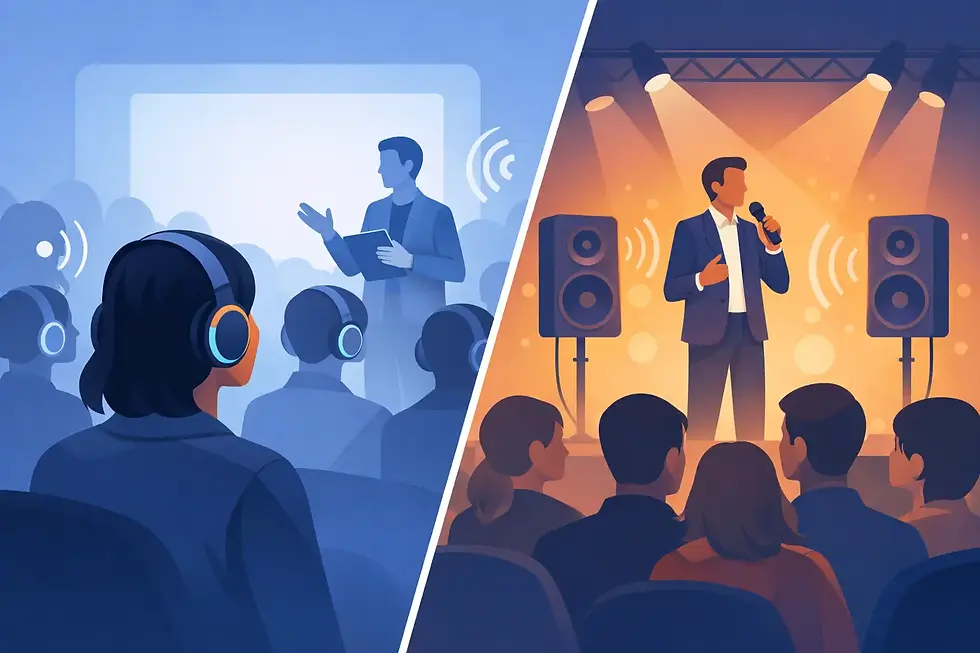
Wireless distribution is often the strongest answer when the venue is loud, open, or shared. It gives you direct-to-listener clarity without forcing more sound into the environment. That is especially useful in trade shows, factories, museum spaces, retail floors, and multi-use venues.
It also supports use cases that standard speakers cannot handle cleanly. Silent presentation zones, multilingual sessions, private listening, guided tours, and assisted listening all benefit from wireless delivery. The audience hears the content they came for, and the room stays under control.
That said, wireless is not automatic. RF-heavy environments need planning. Large attendee counts require smart device logistics. Fast turnover sessions need a smooth handout and collection process. If the event team wants the benefits of wireless without operational friction, system design and onsite support matter as much as the hardware.
Common planning mistakes that hurt results
The first mistake is treating audio as a last-minute production item. By then, room layout, traffic flow, staging, and adjacent programming are already locked in. Audio distribution works best when it is part of the event design, not a patch after the floor plan is final.
The second is underestimating the venue. Hard surfaces, ceiling height, neighboring exhibitors, and public activity all affect intelligibility. A room that seems manageable during setup can become a different environment once attendees arrive.
The third is ignoring accessibility and language needs until registration numbers are final. Assisted listening and multilingual delivery should be planned early, even if final counts change. Waiting too long limits your options.
The fourth is assuming one system should do every job. Sometimes a hybrid approach is the smart move. You might use a PA for ambient reinforcement, wireless receivers for focused listening, and a separate private feed for recording or remote stakeholders. That is not overbuilding. It is matching the tool to the audience.
How to choose the right setup
A practical guide to event audio distribution should lead to decisions, not theory. Start by defining the message path. Who is speaking, where does that audio need to go, and who should not hear it? Then define the environment. Is it quiet or noisy, fixed or mobile, enclosed or open, single-use or overlapping with other sessions?
Next, decide how much control you need. If your event depends on speech clarity, private listening, translation, or multiple simultaneous presentations, targeted distribution should be central to the plan. If the event is simple and the room is contained, traditional reinforcement may cover most of the need.
After that, think operationally. Who will manage device distribution, charging, battery swaps, channel assignments, and presenter support? A great system on paper can still fail if the event workflow is not realistic. This is why consultative setup matters. The right partner does not just drop off equipment. They map the experience from soundcheck through teardown.
Why customization matters more than package pricing
Off-the-shelf packages are appealing because they look simple. But event audio distribution rarely succeeds on package pricing alone. Two events with the same attendee count can need very different audio strategies based on layout, audience behavior, accessibility needs, and competing sound sources.
Customization is what protects the attendee experience. It lets you build around real conditions instead of hoping a standard kit will hold up. Your Event Audio approaches this the way event teams need it approached - as a service problem first and an equipment decision second. That means the system is built to support the presenter, the audience, and the pace of the event, not just the inventory list.
If your event has noise, overlap, multiple audiences, or high expectations for message control, audio distribution is not an extra. It is part of how the event works. Get that piece right, and people stop fighting the room and start hearing what you brought them there to hear.


Comments