
What Is a Closed Circuit Audio System?
If you have ever tried to run a presentation on a loud trade show floor, you already know the problem. Your speaker is talking, the booth next door is talking louder, and half your audience is straining to catch every third word. That is exactly where the question what is a closed circuit audio system starts to matter.
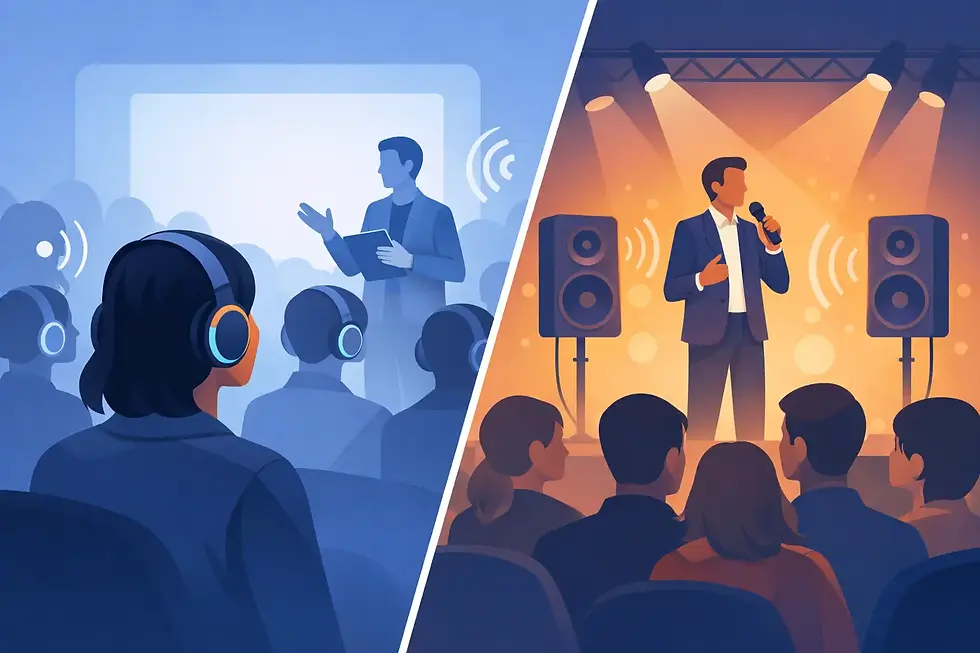
A closed circuit audio system delivers sound directly to a defined group of listeners instead of blasting it into the surrounding space. In practical terms, that usually means a presenter speaks into a microphone, the audio is transmitted through a controlled system, and attendees hear it through dedicated receivers, headsets, or earpieces. The audio stays with the intended audience. It does not need to compete with venue noise, and it does not spill into nearby spaces the way traditional speakers do.
For event organizers, that solves a very specific operational problem. You are not just making audio louder. You are making it more targeted, more intelligible, and more useful in environments where open-air sound reinforcement falls short.
What is a closed circuit audio system used for?
The easiest way to understand it is to compare it to standard PA audio. A PA system projects sound outward into a room or venue. A closed circuit setup sends sound to selected listeners through a private audio path. The audience hears the content clearly, but people outside that listening group do not.
That difference matters in real event conditions. At a conference, it allows one presenter to reach a seated group without disturbing the session next door. At a trade show, it lets a brand run live demos in a crowded booth without adding to the overall floor noise. In retail activations or sports environments, it can deliver guided messaging, commentary, or instructions to the right people at the right time.
It is also widely used for assisted listening and multilingual interpretation. In those cases, a closed circuit audio system is not just a convenience. It can be central to accessibility, comprehension, and audience inclusion.
How a closed circuit audio system works
At the core, the system is straightforward. A presenter, host, interpreter, or event operator speaks into a microphone or feeds audio from a mixer. That signal is transmitted through a controlled wireless or wired path to receivers assigned to listeners. Those listeners use headphones, earbuds, or lightweight headsets to hear the content clearly.
The setup can be simple or highly customized depending on the event. A single presenter may need one transmitter and a bank of receivers. A multi-room conference may need separate channels for multiple speakers, language feeds, or program zones. Some events need roaming coverage across a large footprint. Others need tight containment inside one activation area.
This is where system design matters. The right frequency coordination, receiver count, channel plan, and headset choice all affect the listener experience. A closed circuit system is only as good as its deployment.
Why event teams choose closed circuit audio
Most buyers are not looking for audio theory. They are trying to solve one of a few recurring issues.
The first is noise. Convention halls, expo floors, fan zones, and mixed-use venues are rarely quiet. Even when a PA system is technically working, audience comprehension can still be poor because the listening environment is working against it.
The second is sound bleed. If two presenters are operating near each other, open speaker audio creates interference fast. One message competes with another, and both become less effective. Closed circuit delivery keeps each message in its own lane.
The third is audience control. Not every event message should be public. Some content is intended for registered attendees, VIP groups, tour participants, judges, interpreters, or internal staff. A closed circuit audio system makes targeted communication possible without broadcasting everything to the room.
Then there is accessibility. Assisted listening is one of the clearest use cases because it helps attendees hear a speaker with far less strain. If your audience includes people who need clearer direct audio, a closed system can improve the event experience immediately.
Where closed circuit audio works best
Trade shows are one of the strongest fits. Booth presentations often happen in dense, noisy environments where standard speakers either get lost or create more chaos. Direct-to-listener audio cuts through the noise without turning the booth into a sound war.
Conferences and multi-session events also benefit. When breakout rooms are close together, or when presentations happen in open layouts, closed circuit listening keeps each audience focused on its own session.
Brand activations use these systems for guided experiences, demos, and curated messaging. Instead of hoping people can hear over ambient sound, brands can control the audio experience and keep the presentation polished.
Sports events, facility tours, training environments, houses of worship, museums, and retail promotions can all use the same model. The common factor is simple: you need clear audio for a defined audience in a space where open sound is not the best tool.
What is a closed circuit audio system not?
It is not the same as a standard loudspeaker setup, and it is not automatically the same thing as streaming. Some buyers hear "closed circuit" and think of internet broadcasting or private video feeds. There can be overlap, but closed circuit audio in event settings usually refers to controlled local audio distribution to selected listeners.
It is also not a one-size-fits-all replacement for PA. Sometimes the best solution is a blend of both. A main stage may need room audio for the general audience and closed circuit receivers for assisted listening or language interpretation. A tour guide may need direct wireless audio, while the venue still uses speakers for announcements.
That is why the right answer often depends on the event format, crowd density, venue layout, and audience expectations.
Key features to look for in a closed circuit audio system
Reliability comes first. If the system is going to support a live event, it needs stable transmission, clean sound, and practical receiver management. Dropouts, interference, and weak battery planning create problems fast.
Comfort matters more than many planners expect. If listeners are wearing receivers or headsets for any length of time, fit and ease of use affect adoption. If the gear feels awkward, some attendees will skip it, even if they need it.
Coverage planning is another major factor. A small ballroom and a sprawling expo floor require very different transmission strategies. The same goes for single-channel events versus multilingual or multi-program setups.
Operational support matters too. A strong provider does not just hand over equipment. They help determine channel count, distribution flow, pickup and return logistics, onsite support needs, and contingency planning.
When custom setup matters most
A basic rental package can work for a straightforward event, but many live environments need more than a box of receivers. If you have multiple presenters, overlapping sessions, interpretation feeds, ADA-related listening support, or a venue with difficult RF conditions, customization becomes the difference between a clean show and a stressful one.
This is especially true for trade shows and conferences where every nearby exhibitor is also using wireless technology. Frequency coordination and onsite tuning are not extras in those settings. They are part of making the system dependable.
That is why event teams often work with specialists instead of trying to patch together a generic audio solution. Companies like Your Event Audio focus on matching the system to the communication problem, not forcing the event into a standard package.
Is a closed circuit audio system right for your event?
If your audience struggles to hear, if nearby activity competes with your message, or if you need private or selective audio delivery, the answer is probably yes. The value is strongest when clarity matters more than volume.
That said, it depends on your goals. If you are trying to energize a whole room, public speaker coverage may still be the right tool. If you need focused listening for a defined group, closed circuit audio is often the better fit. Many events use both because each solves a different problem.
The best place to start is not with equipment specs. It is with the event environment. How noisy is the venue? Who needs to hear what? How many simultaneous audio paths are required? Do you need mobility, interpretation, or assisted listening? Once those answers are clear, the right system usually becomes clear too.
When your message matters, hoping people can hear is not a strategy. A closed circuit audio system gives you control, and in busy event environments, control is what turns audio from a technical detail into a better audience experience.


Comments