
How to Reduce Sound Bleed at Events
When two presenters are competing with each other from 30 feet apart, the problem is not enthusiasm. It is audio control. If you are figuring out how to reduce sound bleed at events, the fix usually starts long before anyone touches a microphone. Sound bleed is a planning issue, a system design issue, and often a venue-use issue all at once.
For trade shows, conferences, retail activations, and multi-zone live events, sound bleed can quietly damage the attendee experience. Guests stop focusing. Presenters strain to be heard. Key messages get lost in a wash of competing announcements, music, crowd noise, and nearby demos. The right audio strategy does more than make things louder. It delivers the right message to the right audience without disrupting the rest of the room.
Why sound bleed happens in the first place
Most event sound problems are caused by overlap, not lack of volume. In busy venues, multiple audio sources are often aimed into open space with little separation between audience zones. A standard PA can cover a large area, but that is exactly the problem when you need control instead of reach.
Hard surfaces make it worse. Convention halls, ballrooms, retail environments, and sports venues often reflect sound instead of absorbing it. That reflected audio spreads farther than planners expect, especially when every booth, stage, or activation is trying to push above ambient noise.
Event format matters too. A keynote in a dedicated room has different needs than three product demos running side by side on a trade show floor. If the audio system is not matched to the environment, sound bleed is almost guaranteed.
How to reduce sound bleed at events with smarter layout decisions
The first step is zone planning. Before choosing speakers or microphones, map out where speech needs to be heard and where it should stop. That sounds basic, but it is where many event setups fail. Audio should follow audience boundaries, not floor plan convenience.
Speaker position has a major impact. When speakers fire across walkways or into neighboring exhibit space, you create spill immediately. Aim coverage inward toward the intended listener area, not outward into open traffic. In some environments, lowering speaker height and tightening coverage works better than raising volume.
Distance between active zones also matters. If two presentations must run at the same time, a few extra feet of separation can help, but spacing alone rarely solves the issue in a reflective venue. You need physical layout and audio design working together.
H3 barriers, drape, and structures can help - to a point
Soft goods, scenic walls, branded structures, and pipe-and-drape can reduce some direct spill and improve perceived separation. They are helpful, especially for booths and branded activations, but they are not a replacement for proper audio control. Fabric does not stop a poorly aimed loudspeaker from bleeding into the next area.
Treat these elements as support tools, not the main fix. They work best when paired with targeted speaker placement or a closed-circuit listening approach.
Use directional sound instead of wider coverage
One of the most effective answers to how to reduce sound bleed at events is to stop using broad-coverage audio where targeted coverage is needed. Traditional loudspeakers are often designed to fill space. That is useful for general reinforcement, but not for environments with adjacent presentations, overlapping audiences, or competing content.
Directional speaker strategies let you keep audio focused on a defined listening zone. That means attendees in front of the presentation hear clearly, while nearby areas receive far less spill. You do not always need less sound. You need more control over where that sound goes.
This becomes especially valuable at expos, breakout areas, product launch stations, and retail events where one activation should not hijack the next. A focused system also helps presenters maintain a more natural speaking level rather than pushing harder against the room.
Closed-circuit audio solves the problem at its source
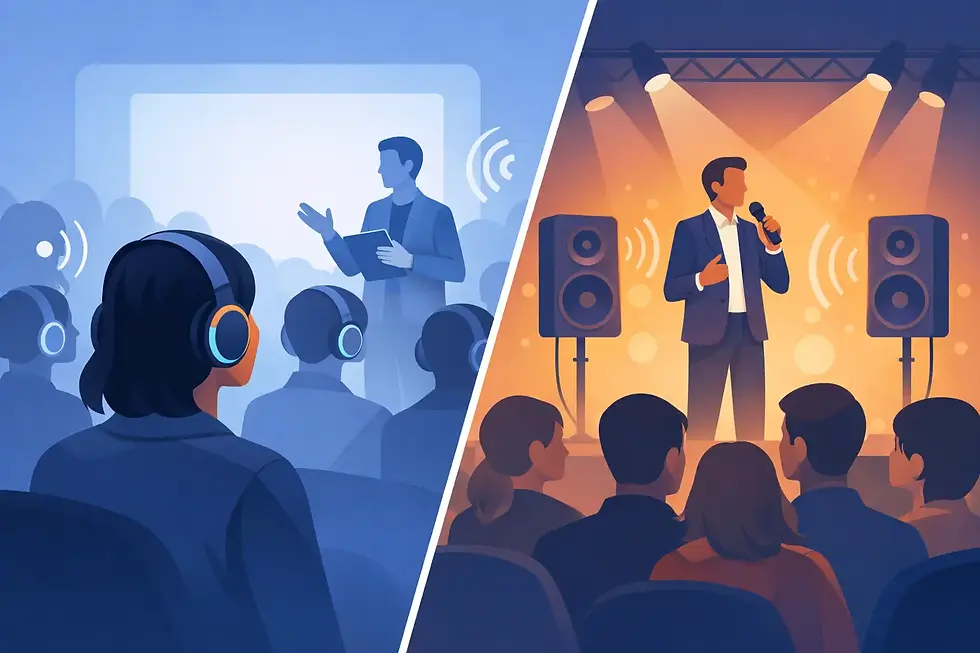
When venue noise is high or presentations are tightly packed, speaker-based solutions can only go so far. That is where wireless closed-circuit audio stands out. Instead of broadcasting into the room and hoping the right people hear it, you deliver the presentation directly to listeners through headsets or receivers.
This changes the event experience immediately. Attendees hear crystal-clear speech without battling ambient noise. Nearby booths, sponsors, and sessions are not disrupted. Presenters do not need to over-project. Organizers gain clean audio delivery without escalating the volume war across the venue.
For many multi-use environments, closed-circuit systems are the most practical way to reduce bleed while increasing comprehension. They are also a strong fit for multilingual presentations, assisted listening, guided event tours, training areas, and private branded experiences.
At Your Event Audio, this is where specialized system design makes the difference. The goal is not just audible sound. It is controlled communication in real event conditions.
Match the system to the event type
Not every event needs the same solution. The right setup depends on audience movement, content type, venue acoustics, and how many sound sources are active at once.
A conference breakout area may benefit from tightly controlled speakers if the room boundaries are clear and scheduling is staggered. A trade show floor with simultaneous demos often needs wireless listening systems because there is no real acoustic separation. A retail activation may require a mix of discreet local reinforcement and headset-based delivery for staff or premium attendees.
This is where customization matters. Off-the-shelf audio setups are usually built for general use. Sound bleed is a specific operational problem, so the solution has to be built around the event itself.
Volume is not the fix most people think it is
One of the most common mistakes at live events is turning up the system to compete with room noise. That can make a local listening area seem clearer for a minute, but it usually creates even more bleed beyond the intended zone. Then nearby exhibitors or presenters respond by increasing their own level, and the room gets harder for everyone.
Better gain structure, better microphone technique, and better speaker targeting usually outperform raw volume increases. A headset mic or properly placed lavalier can improve speech intelligibility at lower output levels than a poorly used handheld. Cleaner input often means less need for aggressive reinforcement.
Music also needs careful management. Low-frequency energy travels and lingers, so bass-heavy playback can bleed far outside the activation area even when the rest of the mix seems under control. If the goal is communication, not nightclub impact, tune accordingly.
Plan for accessibility and clarity at the same time
Reducing sound bleed should not come at the expense of inclusion. In fact, better audio control often improves accessibility. Assisted listening systems, wireless receivers, and direct-to-listener solutions help guests who may struggle in noisy environments, including attendees with hearing challenges, language needs, or attention barriers.
That makes these systems useful beyond compliance. They improve message retention, reduce listener fatigue, and create a more professional experience for every audience segment. If your event includes spoken content that matters, clarity is not a luxury item.
Test in real conditions before doors open
Audio that sounds fine during setup can fail once the room fills with people, music starts, neighboring booths go live, and general crowd noise rises. If possible, test with actual content at event-level conditions. Walk the perimeter. Stand in the next booth. Listen from common traffic lanes. Check what attendees will really hear, not what the operator hears at the mix position.
This is also the time to confirm channel coordination, headset counts, battery readiness, and any multilingual or assisted listening routing. Small pre-show adjustments can prevent major communication problems later.
The best results come from control, not just equipment
If you want to know how to reduce sound bleed at events, start with a simple principle: design for listening zones, not just coverage. Use the room wisely. Keep speaker patterns tight. Avoid solving clarity problems with more volume. And when the environment is too noisy or too dense for open-air reinforcement, move to closed-circuit audio that delivers the message directly to the audience.
That approach protects presenter performance, improves attendee focus, and keeps neighboring spaces functional. In crowded event environments, clear communication is a competitive advantage. The teams that plan for controlled audio are the ones that actually get heard.
If your event has multiple presentations, high ambient noise, or competing audience zones, the smartest move is to solve the bleed problem before show day. A well-designed audio plan does not just make the room sound better. It gives every message a fair chance to land.


Comments