
Audio System for Multiple Presentations
A packed expo hall can ruin a great presentation in minutes. One speaker starts strong, the booth next door turns up their mic, and suddenly attendees are straining to catch half the message. If you need an audio system for multiple presentations, the goal is not just louder sound. It is controlled sound that reaches the right audience without spilling into the next conversation.
That is where standard speaker-and-mic setups usually fall short. In multi-use event spaces, the problem is rarely volume alone. The real issue is competing noise, overlapping sessions, and audiences spread across booths, stages, demo zones, and temporary seating areas. A system built for these conditions has to do more than amplify. It has to direct, isolate, and simplify.
What an audio system for multiple presentations needs to do
When several presentations happen at once, the audio plan has to support both the presenter and the audience. That sounds obvious, but many event setups are still designed as if one room equals one message. In a ballroom with breakouts, a convention floor with side-by-side exhibitors, or a retail activation with rolling demos, that model breaks down fast.
A practical audio system for multiple presentations should let each session speak to its own audience clearly. It should reduce sound bleed between nearby spaces, support easy handoff between presenters, and stay manageable for staff who already have ten other things happening. If attendees need to choose between listening closely and walking away, the system is not doing its job.
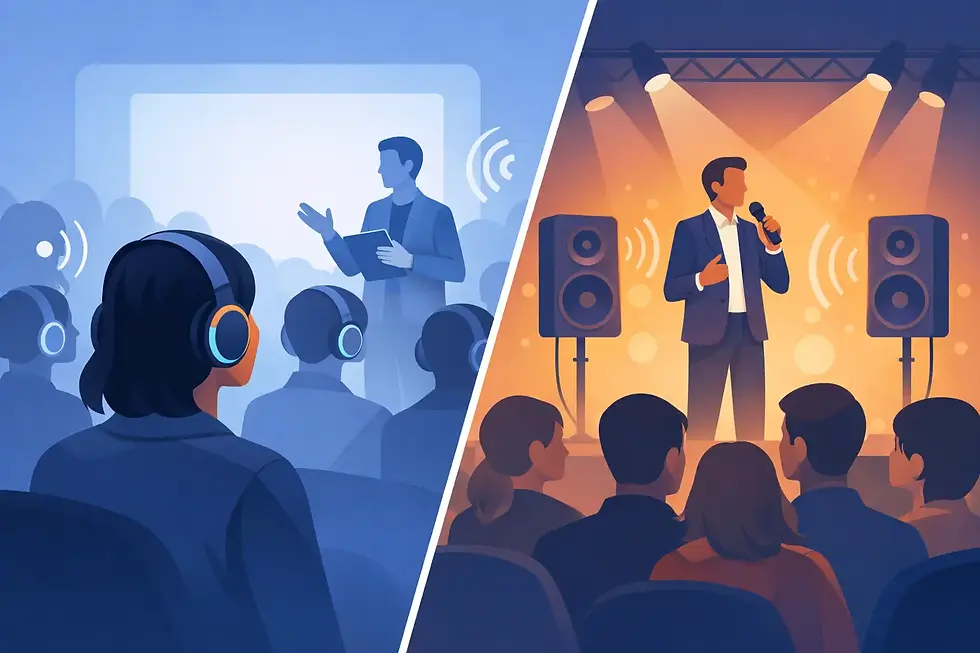
Closed-circuit and wireless listening systems solve this in a different way than traditional PA. Instead of pushing more sound into an already noisy room, they deliver audio directly to listeners through dedicated receivers and headphones. That changes the experience immediately. Presenters do not have to compete with the venue, and attendees do not have to fight to hear.
Why shared spaces create audio problems fast
Most event planners have seen the pattern. A venue looks workable during load-in, then the crowd arrives and the noise floor jumps. Add nearby exhibitors, HVAC noise, open ceilings, concrete surfaces, and roaming announcements, and speech clarity drops fast.
That is especially true when presentations run on staggered schedules. One booth may be doing product demos every 15 minutes while another is hosting a panel discussion, and a third is trying to qualify leads through one-on-one conversations. A conventional loudspeaker setup can create a chain reaction where every area turns up volume to compete. The room gets louder, but comprehension gets worse.
There is also the operational side. Multi-presentation environments often involve different presenters, changing content, quick resets, and mixed audience sizes. A system that sounds good in theory can still fail if it takes too much hands-on adjustment. Simplicity matters just as much as audio quality.
The best-fit solution depends on the event format
There is no single setup that fits every event. The right answer depends on room layout, audience movement, presentation frequency, and whether people are expected to stay in one place or circulate.
For trade shows and expo floors, wireless closed-circuit listening is often the cleanest option. Each booth or presentation zone can broadcast on its own channel, letting attendees tune in without adding more room noise. This works well when presenters need to cut through a busy environment but do not want to disturb neighboring exhibitors.
For conferences with breakout sessions, the answer may be a mix of targeted PA and private listening support. Some rooms need traditional reinforcement because the audience is seated and contained. Others benefit from assistive or multilingual listening systems that help specific attendee groups hear clearly without changing the room mix.
For retail activations, sports promotions, and mobile brand events, flexibility is usually the deciding factor. The system may need to support a host mic, short presentations, music playback, cueing, and selective audience listening in a space that was never designed for formal audio. In those cases, custom configuration matters because the environment changes faster than the run of show.
Key features that make multi-presentation audio work
The most effective systems share a few traits. First, they separate audio by audience rather than forcing everyone in the area to hear everything. That is what keeps presentations intelligible in dense venues.
Second, they are easy to deploy and manage. Event teams do not need another complicated layer. They need channel planning that makes sense, equipment that is reliable, and presenter workflows that are simple enough to repeat all day.
Third, they account for accessibility and inclusion from the start. Assisted listening should not be treated as an afterthought. If part of your audience struggles to hear in a loud environment, the event experience suffers and the presentation loses impact. The right system can support better access while improving clarity for everyone.
A strong setup may also include multilingual delivery, especially for conferences, international trade events, and public-facing activations. If multiple audiences need the same presentation in different languages, private listening channels can keep delivery organized without turning the session into an audio mess.
Where standard PA still helps - and where it does not
Traditional public address has a place. If you are making general announcements, covering a contained room, or supporting a single main stage, speakers and microphones may be exactly what you need. The problem starts when planners expect that same approach to work across overlapping presentations in open or semi-open spaces.
More speakers do not automatically fix clarity. In many venues, they make the problem worse by adding reflections, increasing bleed, and raising overall volume. That does not mean PA is wrong. It means it needs to be used with purpose.
In some events, the best result comes from combining systems. A light PA can support local presence for the presenter, while a wireless listening system carries the spoken content directly to attendees. That gives the session energy without flooding the area with competing sound.
Planning early saves money and stress
Audio problems in multi-presentation settings are expensive when they show up late. Last-minute fixes usually mean extra gear, rushed labor, and compromised results. Early planning gives you more control over channel allocation, presenter flow, audience capacity, and equipment placement.
It also helps clarify what success actually looks like. Do you need listeners to hear one keynote-style presentation in a busy hall, or do you need six simultaneous demos operating side by side all day? Are you trying to support lead generation at booths, training in temporary rooms, or guided listening for VIP groups? Those are different use cases, and they should not be treated as the same problem.
A consultative approach matters here because event audio is rarely one-size-fits-all. The most reliable systems are built around the venue, the agenda, and the behavior of the audience. That is how you avoid overbuilding in one area and underdelivering in another.
Common mistakes to avoid
One of the biggest mistakes is assuming the venue audio package covers everything. Venue systems are often designed for general reinforcement, not for isolated listening across multiple active zones. They may be useful as part of the plan, but they should not be the plan by default.
Another common issue is focusing on equipment before workflow. A technically capable system can still frustrate presenters if mic handoffs are clunky, channels are confusing, or staff need constant troubleshooting support. Ease of use is part of performance.
It is also a mistake to treat audience listening as secondary. If attendees cannot hear comfortably, they disengage quickly. In trade shows and activations, that can mean fewer qualified conversations, shorter dwell time, and weaker message retention. Clear audio is not just a technical detail. It affects business outcomes.
Choosing a partner for an audio system for multiple presentations
If your event includes overlapping sessions, noisy surroundings, or presenter zones that sit close together, ask direct questions before choosing a solution. Can the system isolate audio by audience? Can it scale if attendance grows? Can it support accessibility needs and multiple languages? Can your team run it easily during a live event?
That is the level where experience shows. A provider that specializes in closed-circuit and custom event audio will look beyond gear lists and focus on how people will actually hear, move, and interact on-site. That is the difference between acceptable sound and an event that feels controlled, professional, and easy to follow.
Your Event Audio works in exactly these conditions, where clear communication matters more than raw volume and where customization is the reason the event succeeds.
If you are planning an event with several presenters happening at once, think about the audience first. The right system does not just make sound louder. It gives every presentation a fair chance to be heard.


Comments