
Best Audio Solution for Noisy Venues
A packed expo hall, a ballroom with hard reflective surfaces, or a retail activation with music, crowds, and competing announcements can ruin even the strongest presentation. If you are looking for the best audio solution for noisy venues, the answer is usually not more speaker volume. It is better control - getting the right audio to the right people without adding more noise to the room.
That distinction matters. Many event teams assume the fix is a louder PA system, but in busy environments, louder often means muddier. Speech intelligibility drops, nearby booths complain, and attendees tune out because the room becomes a wall of sound. The better approach is to design audio around the listening experience, not just room coverage.
What actually works in a noisy venue
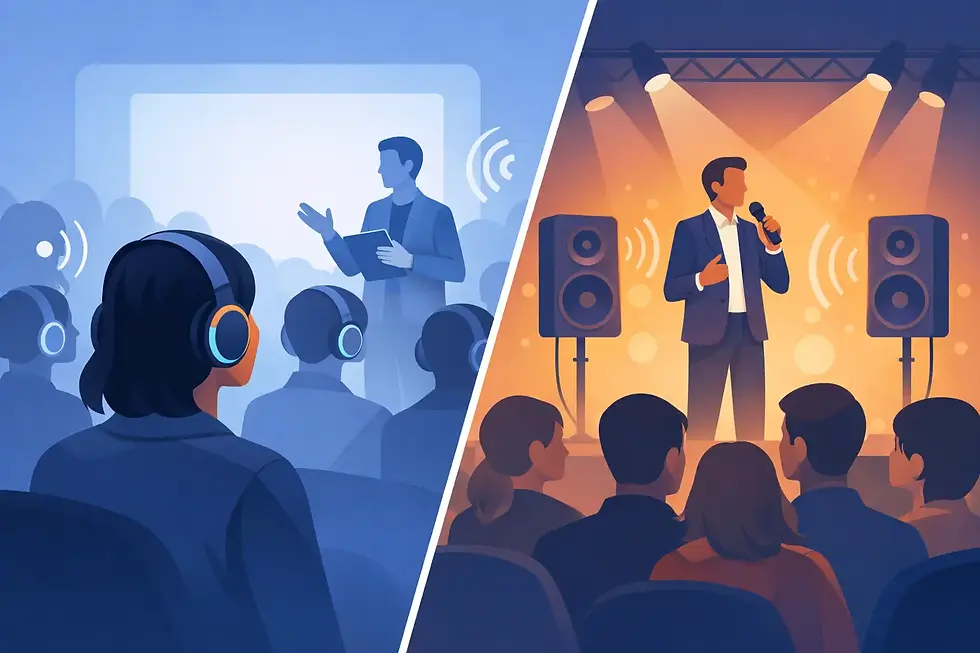
The best audio solution for noisy venues is often a closed-circuit wireless audio system paired with a smart event-specific setup. Instead of pushing sound broadly into a loud space and hoping people catch it, closed-circuit audio delivers clear program audio directly to the listener through wireless receivers and headsets. That gives presenters a better chance of being heard and gives attendees a better reason to stay engaged.
This is why silent presentation systems, assistive listening setups, and multi-channel wireless audio have become such a practical fit for conferences, trade shows, live promotions, and sporting events. They reduce sound bleed, support multiple presentations in the same footprint, and make communication more intentional.
That said, there is no one-size-fits-all system. The right solution depends on what kind of noise you are dealing with, how your audience moves through the space, and whether your goal is public address, private listening, language support, or all three at once.
Why traditional sound reinforcement often falls short
In a controlled room, standard speakers can do the job well. In a venue with constant crowd noise, multiple sound sources, or poor acoustics, they start to work against you.
The first issue is overlap. If several exhibitors or presenters are all trying to project into the same airspace, every extra decibel adds to the problem. Your message may be louder, but it is not clearer. The second issue is distance. People standing at the edge of a crowd or moving through an activation rarely get the same listening experience as those standing front and center.
There is also the operational issue. Event organizers need systems that are reliable, fast to deploy, and easy to manage during live show conditions. A complicated setup that requires constant adjustment is not an asset on event day.
The best audio solution for noisy venues depends on the use case
If you are running a trade show booth presentation, the best setup is usually a wireless closed-circuit system that lets attendees hear a presenter through headsets while the surrounding floor stays undisturbed. This keeps your message clear without creating conflict with neighboring exhibitors. It also creates a more focused experience, which can increase dwell time and improve lead quality.
For conferences with breakout sessions near each other, multi-channel wireless audio can solve two problems at once. It gives each audience a clean feed for its own session, and it prevents one room from bleeding into another. In venues where walls are temporary or room separation is weak, this can make the difference between a professional event and a frustrating one.
For retail activations and live promotions, it depends on whether you need selective listening, broad announcements, or both. Sometimes a hybrid setup works best - a public address layer for general crowd direction and a private wireless layer for deeper brand messaging, guided experiences, or VIP engagement.
Sports and large public events often need zone-based thinking. One message may need to reach staff, another spectators, and another a featured activation area. In those cases, the best system is the one that separates audiences and messages instead of forcing everything through one channel.
Closed-circuit audio gives you control
The biggest advantage of closed-circuit audio is control. You are no longer relying on room acoustics or crowd behavior to carry your message. You are delivering it directly.
That direct delivery improves clarity, but it also opens up more flexibility. You can run multilingual channels, provide assisted listening support, or host multiple presentations side by side. Presenters do not have to strain. Audiences do not have to fight the room to follow along. Organizers can shape the experience instead of reacting to the noise.
This is especially valuable in environments where attention is hard to hold. If attendees can hear comfortably, they are more likely to stay present, absorb information, and respond to a call to action.
What to look for in the best audio solution for noisy venues
Start with intelligibility, not output. If speech is the priority, the system should preserve vocal clarity under real event conditions. That means clean transmission, stable wireless performance, and the right headset or receiver format for your audience.
Next, look at audience flow. A seated audience has different needs than a moving crowd on a trade show floor. If attendees will enter and exit frequently, the system should be easy to distribute, collect, and sanitize. It should also be simple enough that users do not need a long explanation.
Coverage planning matters too. A system may perform well in a test area and fail once the room fills up, staging changes, or other vendors power on nearby equipment. This is where consultative setup becomes important. The best results come from matching the system to the venue, event format, and traffic patterns.
Accessibility should not be treated as an add-on. If your event needs assisted listening support, language channels, or options for different listener needs, those features should be built into the plan from the start.
Finally, consider support. Equipment alone is not the full solution. On-site configuration, frequency coordination, monitoring, and quick troubleshooting can save an event from preventable audio issues. A managed service approach is often the better investment than a pieced-together rental package.
Common mistakes event teams make
One of the biggest mistakes is assuming the room can be conquered with more speakers. In noisy venues, that usually creates more competition, not more clarity.
Another mistake is treating every event the same. A product demo in a convention center, a shareholder presentation in a flexible meeting space, and a fan engagement zone at a sporting event all have different communication demands. The audio plan should reflect that.
Teams also underestimate listener fatigue. When people have to work to hear, they check out faster. Clear targeted audio is not just a technical upgrade. It affects participation, retention, and audience behavior.
Then there is timing. Audio decisions made late in the planning process often lead to compromises. If noisy conditions are predictable, the solution should be part of the original event design, not a last-minute fix.
Where a custom setup makes the difference
A custom audio approach matters most when the event has competing sound sources, multiple presenters, accessibility requirements, or branded experience goals. Those situations demand more than generic reinforcement.
For example, a trade show producer may need ten adjacent mini-theaters to operate at once. A conference planner may need silent breakout rooms in an open hall. A retailer may want promotional energy in one area without overwhelming shoppers in another. These are different problems, but they all point toward the same principle: targeted delivery beats uncontrolled volume.
This is where a service-driven partner adds value. The system can be designed around your venue, audience size, presentation format, and operational goals instead of forcing your event into an off-the-shelf setup. Your Event Audio works in exactly that space, helping organizers cut through venue noise with wireless and closed-circuit systems built for real event conditions.
Choosing the right path for your event
If your venue is loud, your event likely does not need a bigger sound system. It needs a smarter one. The best audio solution for noisy venues is the one that gives you control over who hears what, where they hear it, and how clearly it lands.
For some events, that means silent conference headphones. For others, it means assistive listening, multilingual channels, a hybrid PA strategy, or a fully customized wireless setup. The right answer depends on your audience and your environment, but the goal stays the same: cut through the noise without adding to it.
When attendees can hear clearly, everything else works better - presentations hold attention, messaging stays consistent, and the event feels more organized from the inside out. That is the kind of audio decision people notice, even when they never think about the gear behind it.


Comments