
How to Improve Expo Booth Audio Fast
The problem usually starts five minutes into the show. Your presenter is speaking, the aisle traffic picks up, the booth next door starts a demo, and suddenly your message is competing with everything at once. If you're figuring out how to improve expo booth audio, the answer is rarely turning the speakers up. Better booth audio comes from control, coverage, and choosing the right delivery method for the space.
Expo floors are built for distraction. That means standard sound reinforcement often works against you. Loud speakers can create spill into neighboring booths, cause listener fatigue, and still fail to reach the people you actually want to engage. The better approach is to design audio around how attendees move, where they stop, and how they prefer to listen.
How to improve expo booth audio in noisy venues
The first step is to stop treating booth audio like a small stage show. A trade show booth is a communication environment, not just a sound system placement problem. People are walking, talking, checking phones, and splitting attention between multiple brands. Your audio setup has to deliver clarity quickly.
That usually means narrowing the listening zone instead of widening it. If your booth relies only on open-air speakers, you're asking your audience to separate your message from the noise around them. In some spaces, that can work for broad announcements or light music. In most expo settings, it leads to muddiness and wasted volume.
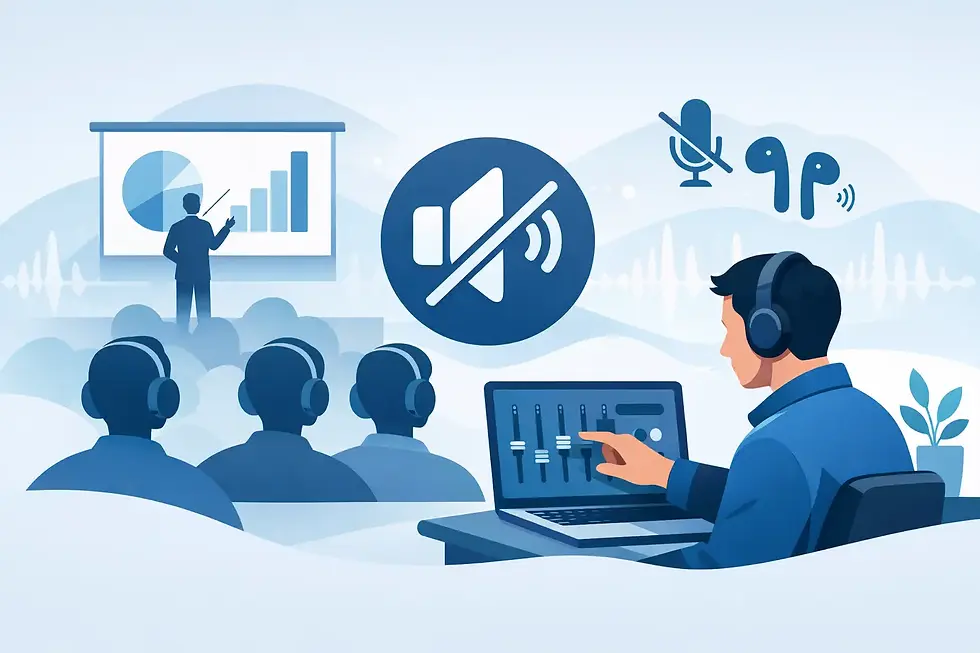
Closed-circuit audio often solves this better. Wireless headsets let attendees hear your presenter clearly without forcing the entire aisle to listen. That changes the interaction. People can focus, your team can speak at a more natural level, and nearby exhibitors are less likely to be affected by your activation.
There is a trade-off. Headset-based listening is more intentional than open playback, so you need staff who can invite people in and explain the experience quickly. But if your goal is message retention and cleaner engagement, it is usually the stronger option.
Start with the booth goal, not the gear
Before you choose microphones, speakers, or headsets, define what the booth audio needs to do. A product demo has different requirements than a speaking session, multilingual presentation, or retail-style promotion. The wrong system is often the result of skipping this basic planning step.
If your booth is built around one presenter speaking to a gathered audience, speech intelligibility matters most. That points to a well-managed microphone setup and focused attendee listening. If the booth has multiple stations or repeat demos throughout the day, you may need separate audio zones or private listening channels. If your objective is lead capture through one-on-one conversations, background music should stay controlled and secondary.
This is where many teams overspend in the wrong place. They rent bigger speakers when what they really need is targeted audio delivery. They add more volume when what they need is less bleed. They put a handheld mic in a presenter's hand when a headset mic would keep level and clarity more consistent.
The biggest booth audio mistakes
Most expo booth audio problems come down to a few common issues. The first is excessive speaker volume. Louder is not clearer, especially in convention halls with reflective surfaces and constant competing noise.
The second is poor microphone choice. Built-in laptop mics, low-grade wireless units, or badly positioned lavaliers can make even a strong presenter sound distant. A good microphone matched to the speaker and the environment makes a bigger difference than most planners expect.
The third is uneven coverage. One person in front hears everything, while people just outside the center line hear almost nothing. That is a system design problem, not a presenter problem.
The fourth is ignoring accessibility and language needs. If part of your audience struggles to hear, or if you are trying to serve attendees in more than one language, standard speaker-only audio leaves people out.
Choose the right audio format for the space
There is no single best setup for every booth. It depends on aisle width, crowd density, presentation style, and venue rules. But in general, the most effective expo audio systems fall into a few categories.
Open-air speaker setups work best when you need ambient sound, light announcements, or broad brand presence in a controlled footprint. They are simple, but they can become a problem if the hall is already loud or if nearby exhibitors are close.
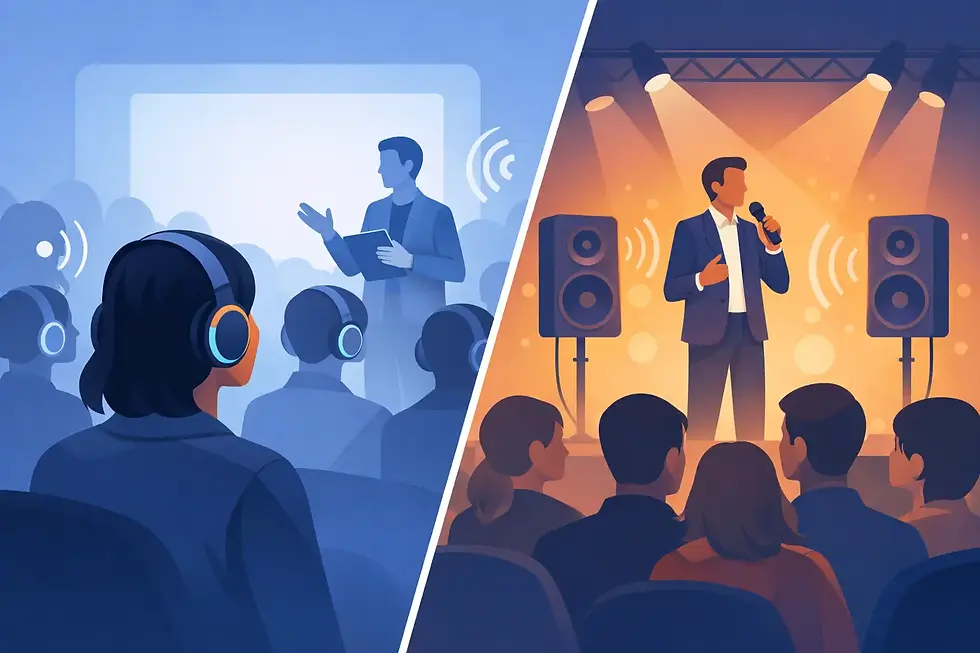
Wireless silent presentation systems are often the strongest choice for demos, educational content, and scheduled talks. Attendees wear headphones and hear the presenter directly. This cuts through venue noise and prevents sound spill. It also creates a more premium, focused experience.
Hybrid systems combine public address support with private listening. That can work well when you want to attract attention publicly, then move serious prospects into a more controlled audio experience. The key is balance. Public audio should invite, not overwhelm.
How to improve expo booth audio with better mic technique
Even the best system will struggle if the microphone setup is wrong. For presenters who move, a headworn or properly fitted lavalier mic usually gives more consistent speech pickup than a handheld. It keeps the speaker's voice at a stable level and reduces the risk of drifting off mic.
For panel-style conversations or fixed demo stations, tabletop or gooseneck microphones can work, but only if placement is deliberate. Too far from the mouth, and speech gets thin and noisy. Too close, and you pick up plosives and handling noise.
Presenter coaching helps too. Fast speech, turning away from the audience, and inconsistent distance from the mic all hurt clarity. You do not need a media trainer on site, but you do need a quick sound check and basic instruction before the floor opens.
Control sound bleed before it starts
Sound bleed is one of the fastest ways to lose goodwill at a show. It frustrates neighboring exhibitors, confuses attendees, and can trigger venue intervention. Once your booth is known as the noisy one, your team is on the defensive.
Directional speaker placement can help, but there are limits in open expo halls. Booth structures, hard surfaces, and crowd flow all affect how sound travels. That is why many organizers move toward targeted listening solutions instead of trying to overpower the room.
If your booth includes simultaneous demos, multilingual tracks, or multiple presenters, private wireless audio is even more useful. It lets each attendee hear the right content without adding more noise to the floor. That is cleaner for operations and stronger for audience focus.
Plan for accessibility and multilingual delivery
Better booth audio is not only about volume and clarity. It is also about making sure more people can actually follow the content. Assisted listening options can support attendees with hearing challenges without changing the presentation flow for everyone else.
Multilingual audio is another practical advantage. If your booth serves a diverse audience, separate listening channels can deliver translated content directly to attendees. That keeps the presentation organized and avoids the confusion of overlapping spoken translation in the booth space.
For event teams, this matters operationally as much as experientially. Clearer delivery means fewer repeated explanations, fewer missed key points, and a smoother path from presentation to conversation.
Test under show conditions, not in theory
A booth audio system that sounds good during setup can fall apart once the floor fills in. People absorb and reflect sound differently than empty space. Neighboring booths activate. General noise rises. What felt fine at 8:00 a.m. may be ineffective by 11:00 a.m.
That is why pre-show testing should include realistic conditions as much as possible. Run the full signal path. Test microphones at presentation level. Walk the booth perimeter. Stand in the aisle. Listen from the attendee perspective, not only from the control position.
A service-driven audio partner will account for this and adjust quickly. In expo environments, flexibility matters just as much as equipment quality. If coverage needs to shift or listening demand increases, the system should be able to adapt without disrupting the booth schedule.
Make audio part of the attendee experience
The strongest booth audio setups do more than make speech louder. They make the experience easier to join. When people can hear clearly, they stay longer, ask better questions, and remember more of what they heard.
That is the real answer to how to improve expo booth audio. Build for attention, not just amplification. Use the format that fits the environment. Keep the message controlled, focused, and easy to follow. If you want attendees to hear the value of what you're presenting, your audio system has to do the same job your team does - cut through the noise with purpose.
If your next booth needs clearer delivery in a crowded hall, start with the listening experience you want people to have, then build the system around that.

Comments