
Wireless Event Audio System That Cuts Noise
Crowded expo halls, multi-room conferences, retail activations, and live promotions all create the same problem: people can see what is happening, but they cannot always hear it clearly. A wireless event audio system fixes that gap by delivering focused, controlled sound directly to the audience you need to reach. Instead of fighting venue noise with more speaker volume, you create a better listening experience for attendees, presenters, staff, and guests who need reliable clarity.
That shift matters more than many event teams realize. When audio is inconsistent, attention drops fast. People miss key messages, tune out a presenter, or walk away from a booth because the environment feels chaotic. When the sound is targeted and easy to follow, the same space becomes more usable, more professional, and more effective.
What a wireless event audio system actually does
At its core, a wireless event audio system sends audio from a source such as a microphone, presentation feed, interpreter channel, DJ mix, or emcee program to wireless receivers or connected listening points. The goal is not just amplification. The goal is controlled delivery.
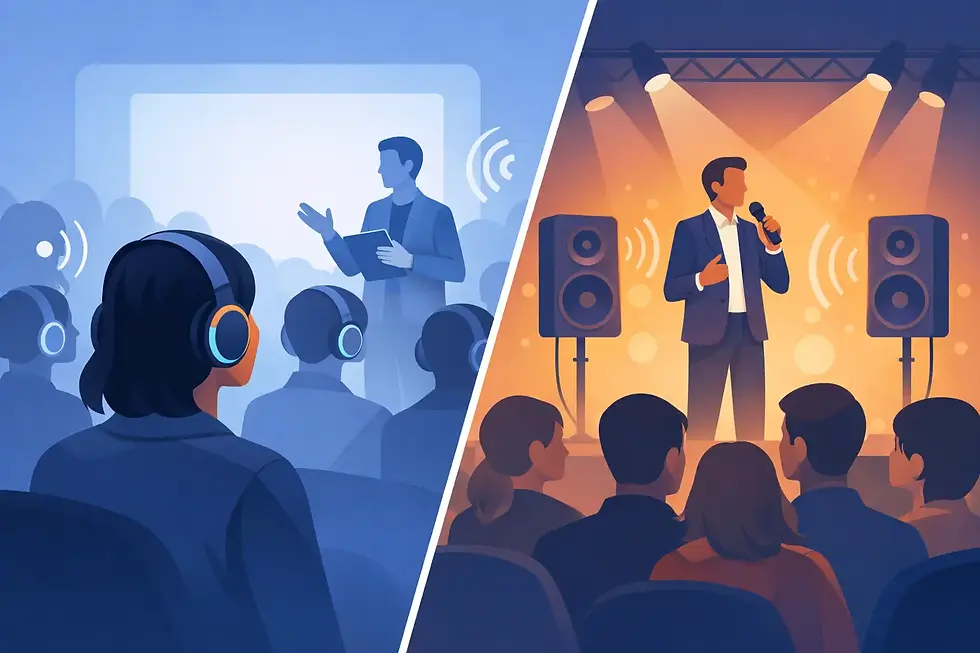
That distinction is what makes these systems valuable in live event environments. Traditional loudspeakers push sound into a room. That works in some settings, but in noisy or shared spaces it often creates spill, overlap, and listener fatigue. A wireless system gives event organizers more control over who hears what, where, and at what level.
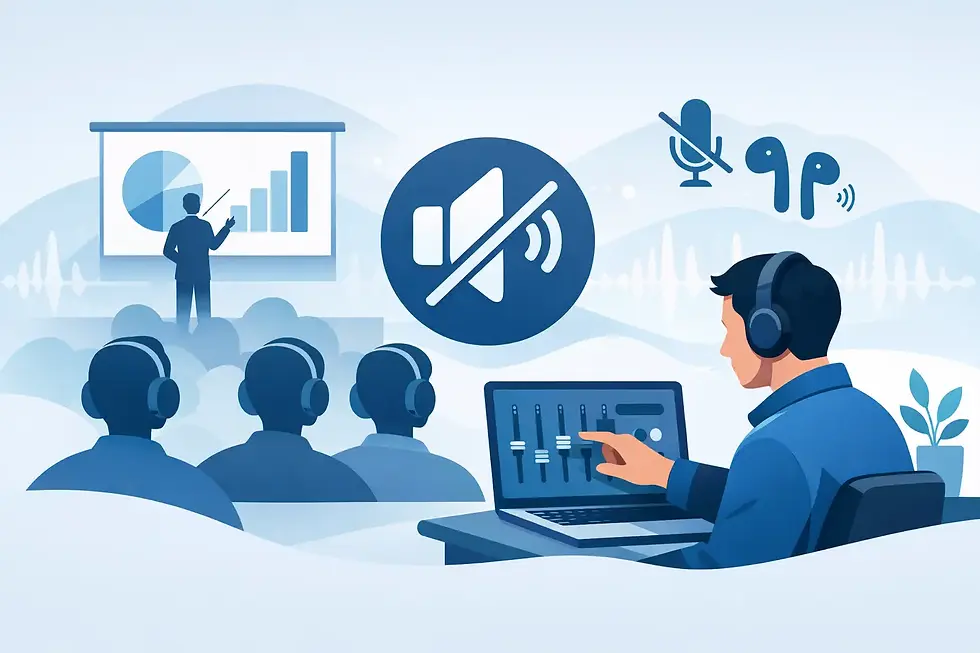
For some events, that means silent conference sessions on a trade show floor. For others, it means multilingual interpretation, assisted listening, private event broadcasting, overflow audio, or a branded listening experience that keeps attendees engaged without raising room volume. The setup depends on the event, which is why custom configuration matters.
Where wireless event audio systems make the biggest impact
Trade shows are one of the clearest examples. You may have multiple exhibitors presenting within a few feet of each other, all competing against crowd noise, announcements, and general floor activity. A presenter can have a strong message and a great product demo, but if attendees cannot hear clearly, performance suffers. A wireless event audio system lets that booth or activation deliver clean sound without battling every neighboring speaker.
Conferences face a different version of the same issue. Breakout rooms may be close together. General sessions may need overflow support. Some attendees may need assisted listening. Others may need interpretation channels. In these cases, the system is not only about sound quality. It is about making the event easier to navigate and easier to understand.
Retail activations and brand promotions also benefit because they happen in active, unpredictable environments. Stores, malls, and public venues are full of distractions. If your staff, emcee, or featured guest is trying to deliver a message, relying on ambient room sound is risky. A closed-circuit wireless setup can help you hold attention without turning the space into a noisy mess.
Sporting events, community events, and live promotions often need a blend of public address, staff communication, and controlled listener audio. In those cases, the right setup may combine open speaker coverage with a more targeted wireless layer. It depends on the audience flow, venue layout, and the kind of experience you want people to have.
Why standard PA is not always enough
Many organizers start with a simple assumption: if attendees cannot hear, just add more speakers or increase volume. That can work in a quiet room. In a loud venue, it often makes things worse.
More volume usually means more bleed into nearby spaces, more reflections, and more competition between sources. If several booths or rooms take the same approach, the entire venue gets louder while intelligibility gets worse. People hear noise, not content.
A wireless event audio system solves a different problem than a standard PA. It is built for precision. You can direct the listening experience instead of flooding the space. That is especially useful when the event includes overlapping sessions, side-by-side demonstrations, accessibility needs, or environments where audience attention is already limited.
There is a trade-off, of course. Not every event needs individual receivers or private channel delivery. For a simple outdoor announcement, traditional reinforcement may be enough. But when your event depends on speech clarity, message retention, or multiple simultaneous audio experiences, targeted wireless delivery is often the better operational choice.
The business case for controlled audio
Clear audio is not just a technical upgrade. It affects outcomes.
For exhibitors and brand teams, it can increase dwell time and improve demo engagement. People stay longer when they can actually follow the presentation. For conference planners, it can reduce confusion and improve session quality without creating sound conflicts between rooms. For venues, it can support more flexible event formats. For presenters, it removes one of the biggest barriers to audience connection.
There is also an accessibility component that should not be treated as an afterthought. Assisted listening support helps more attendees participate comfortably, and it signals that the event was planned with care. The same is true for multilingual audio. If your audience includes multiple language groups, controlled wireless channels can make the event more inclusive and far more usable.
When audio is handled well, the event feels organized. When it is not, the flaws are obvious. Guests may not know the source of the problem, but they feel the friction immediately.
Choosing the right wireless event audio system
The right solution starts with the use case, not the hardware list. A good planning conversation usually begins with a few practical questions. Is the environment loud? Will multiple presentations happen at once? Do you need one-to-many broadcast audio, interpretation, assisted listening, private staff feeds, or a mix of all three? How mobile is the audience? What kind of setup window do you have on-site?
Coverage area matters. So does channel planning. Battery management, receiver count, microphone coordination, and signal reliability all matter too. A system that works perfectly for a 50-person breakout will not necessarily scale well for a trade show activation with constant attendee turnover.
Ease of use is another factor event teams sometimes underestimate. The more complicated the listener experience, the more support you will need on-site. That does not mean advanced setups are a bad idea. It means they should be designed around the audience and the operating team.
This is where a consultative approach makes a real difference. A provider that understands event flow can recommend a setup that fits the venue, the audience, and the event goal instead of forcing a one-size-fits-all package. For many producers, that is the difference between having audio equipment and having an audio solution.
Custom setups win in real venues
Live events rarely happen in ideal acoustic conditions. Floors are noisy. Ceilings are high. Walls are temporary. Crowds move. Schedules change. A system has to perform in the actual environment, not just on paper.
That is why custom deployment matters. One event may need a presenter-focused listening system for a crowded booth. Another may need multilingual channels for a conference session. Another may need private remote broadcast support combined with PA and emcee services. The value comes from matching the system to the event, then supporting it through setup, operation, and breakdown.
For decision-makers, this reduces risk. You are not left trying to patch together consumer gear or guess at frequency coordination during load-in. You get a configuration built for professional use, with a team that understands how event audio behaves under pressure.
Your Event Audio works in that space by focusing on crystal clear audio solutions for live environments where standard sound reinforcement falls short. That kind of specialization matters when the event has no room for communication breakdowns.
What to expect from a professional partner
A good event audio partner should do more than deliver equipment. They should help define the right listening strategy, identify likely problem points, and build a setup that supports the event goal from start to finish.
That may include pre-event consultation, demo options, channel planning, microphone integration, audience receiver management, interpreter support, on-site technicians, and coordination with venue staff or producers. The exact service level depends on the event. A small activation may need a fast, simple deployment. A conference with multiple simultaneous sessions may need much deeper planning.
What should stay consistent is reliability. If your audience depends on hearing the message clearly, then audio cannot be treated as a last-minute line item.
Cut through the noise without adding more noise
The best wireless event audio system does not simply make things louder. It makes communication clearer, more targeted, and more usable in environments where attention is hard to win. That is what helps a presenter connect, helps a brand hold interest, and helps an event feel professionally run.
If your venue is busy, your sessions overlap, or your audience needs more than basic speaker coverage, it is worth treating audio as part of the experience design. When people can hear exactly what they came to hear, everything else works better.

Comments