
Custom Event Audio Setup That Cuts Noise
A keynote starts on time, the booth next door turns up its mic, and half your audience misses the first 30 seconds. That is exactly where a custom event audio setup earns its keep. When your event happens in a loud, shared, or fast-moving environment, standard speakers alone do not give you enough control. You need audio that reaches the right people, in the right place, at the right volume.
That need shows up everywhere - trade show floors, breakout rooms, retail activations, sports venues, conferences, and live promotions. If attendees are straining to hear, presenters are competing with background noise, or multiple sessions are happening side by side, audio stops being a support item and becomes part of the event strategy.
Why a custom event audio setup matters
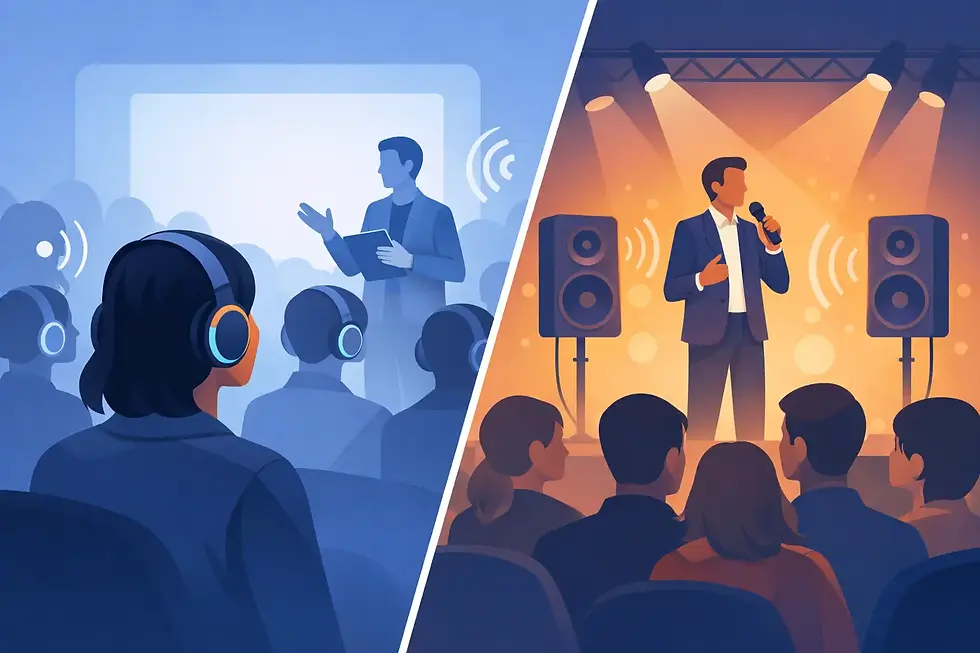
Most event audio problems are not caused by a lack of equipment. They come from using the wrong delivery method for the space, crowd, and goals. A ballroom keynote has one set of demands. A trade show demo in an open hall has another. A bilingual presentation, an assisted listening requirement, or a silent activation changes the setup again.
A custom event audio setup is built around those variables instead of forcing every event into the same speaker-and-mic package. That gives you better message control, less sound bleed, clearer presenter delivery, and a better attendee experience.
For planners, that translates into fewer complaints, fewer missed cues, and stronger engagement. For brands and presenters, it means your message is actually heard instead of getting lost in room noise. For venues, it helps manage overlapping activity without turning every area into a volume war.
Where standard audio falls short
Traditional PA systems work well when one audience is gathered in one space and ambient noise is manageable. Once those conditions change, weaknesses show up quickly.
Open-floor environments are a common example. At trade shows and expos, multiple booths are all trying to attract attention at once. Turning up the speaker volume may help for a moment, but it also spills into neighboring spaces and makes the whole area harder to work in. The result is familiar: tired attendees, frustrated exhibitors, and presentations that feel harder to follow than they should.
The same problem happens in multi-room conference areas with movable walls, retail spaces with constant foot traffic, and public events where announcements need to reach staff or selected attendees without overwhelming the entire venue. In those cases, broad sound reinforcement can create as many problems as it solves.
That is why custom design matters. Sometimes the answer is a stronger PA system. Often it is a mix of wireless receivers, presenter microphones, silent conference audio, assisted listening support, and controlled routing that keeps communication targeted.
What goes into a custom event audio setup
A strong setup starts with the event plan, not the gear list. The first question is simple: who needs to hear what, and where?
If one presenter is speaking to one contained audience, the path may be straightforward. If you have exhibitors giving demos every 20 minutes, VIP guests needing private audio, or attendees selecting from multiple language channels, the design needs to do more. Audio routing, receiver count, mic type, coverage zones, and staff workflow all start to matter.
Audience environment
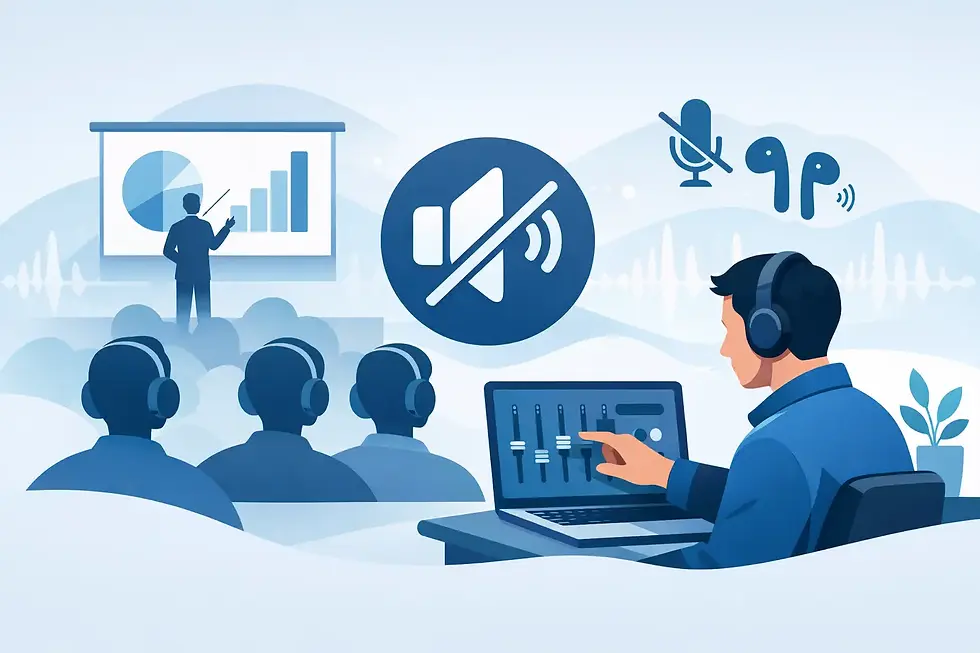
Noise level changes everything. A quiet corporate room can rely on conventional reinforcement. A crowded expo floor usually cannot. In louder environments, closed-circuit and wireless listening systems allow attendees to hear clearly without competing with the room.
This is where focused listening becomes a business advantage. Instead of broadcasting to everyone, you deliver clean audio directly to the intended audience. That protects clarity and improves attention.
Presenter needs
Not every presenter works the same way. Some stay planted at a podium. Others move through a booth, interview guests, or lead interactive product demos. Mic choice, monitoring, and mobility support should reflect that.
A good custom event audio setup accounts for presentation style, not just room dimensions. If the speaker needs to move freely, a handheld-only plan may create friction. If multiple hosts are rotating in and out, handoff timing and battery management become part of the design.
Accessibility and language support
Accessibility is not an extra feature. For many events, it is a requirement. Assisted listening systems help attendees hear more comfortably and confidently, especially in acoustically difficult rooms or noisy public settings.
Multilingual audio adds another layer. When guests need language-specific channels, the setup has to stay easy to use while preserving clear delivery. If channel selection is confusing or the equipment is poorly staged, the audience feels that immediately.
Operational simplicity
The best audio plan in the world still fails if it is hard to run under event pressure. Equipment should be easy to distribute, simple to manage, and dependable during live use. That matters for check-in teams, stage managers, booth staff, and presenters who do not have time to troubleshoot in front of an audience.
Custom does not mean complicated. It should mean better fit.
Custom event audio setup for common event types
Different environments call for different solutions, and that is the whole point.
For trade shows, the priority is usually controlled listening in an open, noisy hall. Wireless headset receivers and silent presentation systems help exhibitors speak to engaged prospects without adding more floor noise. Attendees hear the message clearly, and neighboring booths are not forced into a volume battle.
For conferences, the issue is often overlap. Breakout sessions, keynote rooms, overflow areas, and hybrid communication needs can all exist in the same event footprint. A custom event audio setup can separate those functions cleanly while supporting presenter confidence and attendee comprehension.
For brand activations and retail events, mobility matters. Audio may need to move with the experience, support emcee-driven moments, or deliver targeted content in spaces where shoppers and general foot traffic are part of the environment. Clarity has to happen without making the activation feel intrusive.
For sports and live promotions, timing matters just as much as volume. Announcements, sideline communication, crowd engagement segments, and sponsor messaging all need to hit the right audience at the right moment. A generic setup can cover the field with sound. A custom one supports the full run of show.
The value of consultative design
A lot of event teams have had the same experience: they rent audio equipment, set it up, and spend the event adjusting around predictable problems. Dead spots, muddy speech, interference, and coverage gaps rarely come as a surprise. They come from not designing for the actual event conditions.
A consultative approach fixes that earlier. It looks at the venue, room use, audience flow, presentation schedule, and communication goals before anything is deployed. That reduces waste and usually improves results with more precision, not just more hardware.
It also helps with trade-offs. Not every event needs the same level of build. A small internal presentation may only need straightforward reinforcement and a few wireless components. A high-traffic expo booth may benefit more from silent audio than from louder speakers. A multilingual conference may require channel planning and on-site support from the start.
The right partner will tell you where standard audio is enough and where it is not.
What to look for in an audio partner
If your event lives in a noisy, shared, or high-distraction environment, look for a provider that understands more than speaker coverage. You want a team that can design around audience behavior, presentation style, and communication control.
That means asking practical questions. Can they support closed-circuit listening? Can they handle assisted listening and multilingual applications? Can they configure systems for multiple simultaneous presentations? Can they adapt the setup to your venue rather than offering a one-size-fits-all package?
It also means looking at service. Responsive planning, clear recommendations, on-site reliability, and the ability to demo or explain options matter. For many event teams, that support is what turns audio from a stress point into a solved problem. That is where a company like Your Event Audio stands apart - not by pushing more gear, but by building a setup around what your audience actually needs to hear.
Better audio creates better event outcomes
When attendees can hear clearly, they stay longer, engage more, and miss less. Presenters speak with more confidence. Staff spend less time repeating instructions. Brands get more value from every presentation minute. None of that is accidental.
A custom event audio setup gives you control where standard sound often falls short. In busy venues, that control is the difference between being audible and being effective.
If your event has noise, overlap, accessibility needs, or multiple listening scenarios, audio should be designed with the same care as staging, scheduling, and audience flow. The clearer the message path, the stronger the event feels from start to finish.

Comments