
Sports Event Announcer Audio System Guide
A missed starting call, a garbled award announcement, or a sponsor read nobody can understand can throw off an entire game day. A sports event announcer audio system has one job above all else - make every word clear, on time, and easy to hear in a loud, unpredictable environment.
That sounds simple until you factor in crowd noise, wind, venue layout, multiple field areas, walk-up music, emergency messaging, and staff communication. Standard PA setups often work for basic amplification, but sports events usually need more control than that. The best results come from a system designed around the announcer, the audience, and the way the event actually moves.
What a sports event announcer audio system needs to do
At most events, the announcer is carrying more than play-by-play. They are giving timing cues, recognizing sponsors, managing ceremonies, directing participants, and helping keep the event organized. If the audio is unclear, the whole event feels less polished.
A strong sports event announcer audio system should deliver vocal clarity first. Music matters, but speech intelligibility is what keeps the event running. That means the system has to handle the announcer's voice cleanly without feedback, distortion, or volume swings.
Coverage matters just as much. A baseball field, 5K course finish line, indoor court, or multi-zone tournament space all create different challenges. Some venues need even sound spread across a single audience area. Others need targeted coverage so one field does not compete with another. If sound spills everywhere, people hear noise instead of information.
Reliability is the other non-negotiable piece. Live sports do not pause because of a dead handheld mic or a bad cable path. Equipment has to be chosen for the environment, tested in advance, and supported by a setup plan that accounts for weather, power access, and backup options.
Why standard PA is not always enough
A lot of sports coordinators start with whatever speakers and microphone package is easiest to rent or already sitting in storage. That can work for a small gathering, but it often falls short once the crowd grows or the venue gets louder.
The issue is not just volume. Turning the system up higher usually creates more problems than it solves. Speech can become harsh, feedback becomes more likely, and nearby zones may hear too much of the wrong content. In a busy sports environment, clarity beats raw loudness every time.
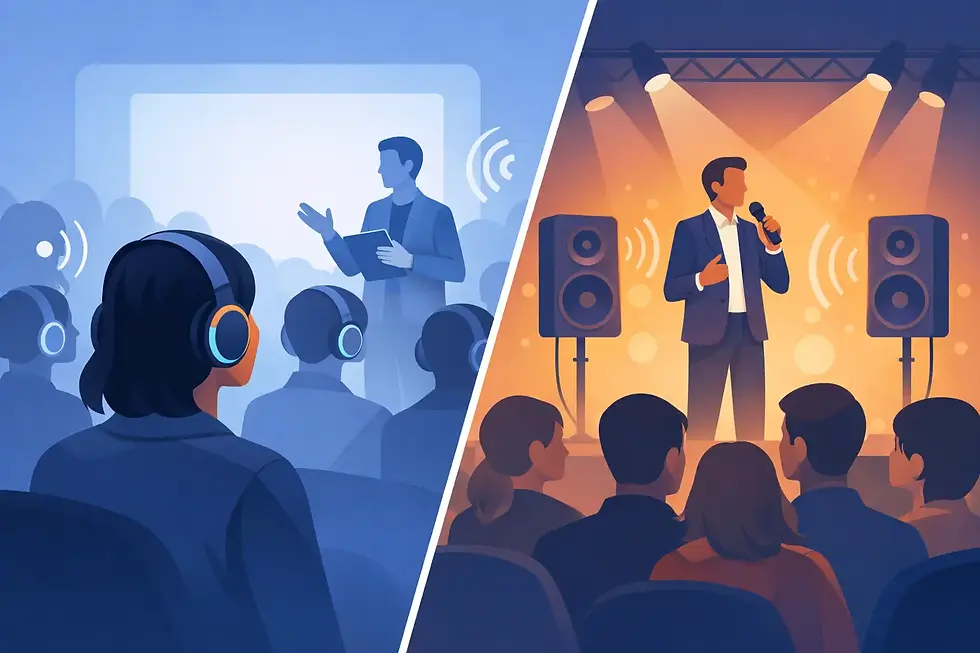
This is where a more customized approach changes the outcome. Closed-circuit listening, distributed speaker placement, wireless announcer options, separate feeds for staff, and zone-based control all help deliver the right message in the right place. For some events, public-facing speakers are enough. For others, a mix of public address and controlled listening is the better answer.
Core components that affect performance
The microphone is the first place to get serious. The wrong mic can make a confident announcer sound distant, thin, or inconsistent. A quality handheld or headset microphone matched to the announcer's style gives better gain before feedback and more stable vocal presence. If the announcer is moving around, wireless matters, but wireless also requires frequency planning and battery discipline.
The mixer is where control happens. It balances announcer voice, music playback, sponsor reads, walk-up tracks, and any guest microphones. For sports events, fast access matters. The operator should be able to mute music instantly, bring up a referee or host microphone, and adjust levels without slowing down the event.
Speakers need to match the venue, not just the budget. Indoor gyms reflect sound differently than outdoor fields. Bleachers, concrete walls, open air, and track layouts all change how audio behaves. Speaker placement, aiming, and delay planning often matter more than choosing the biggest cabinet available.
Then there is monitoring and communications. If event staff cannot hear cues clearly, timing suffers. In some cases, organizers need private audio channels for production teams, judges, coaches, or presenters. That is especially helpful at tournaments, ceremonies, and events with multiple moving parts.
Choosing the right setup for the venue
Small community events usually need simplicity and speed. A compact announcer station, one or two properly positioned speaker zones, wireless microphones, and clean music playback may be all that is required. The goal is quick setup and dependable coverage without overbuilding.
Mid-size school, club, and regional events often need more flexibility. There may be a main announcer, auxiliary music sources, remote cues, and changing audience positions throughout the day. This is where scalable system design starts to matter. The setup has to support the event from opening announcements through awards without constant troubleshooting.
Large venues and multi-area events require a different level of planning. You may need separate audio zones, protected announcer positions, backup microphones, distributed coverage, and private listening solutions for staff or VIP groups. If two activities are happening near each other, controlling sound bleed becomes a major priority.
Outdoor events add another layer. Wind affects microphones. Weather affects equipment placement. Open spaces can make sound seem weaker at a distance even when the system is technically loud. A good outdoor design accounts for all of that before the first attendee arrives.
Sports event announcer audio system options by use case
Different events ask for different solutions. A youth tournament may need announcer audio and music across a central field complex. A road race may need start-line energy, finish-line clarity, and remote audio support at checkpoints. A stadium-side activation may need sponsor messaging without overpowering the main event.
That is why one-size-fits-all packages tend to disappoint. The right sports event announcer audio system should be built around the flow of the day. Who needs to hear what? Where do announcements originate? Does the event require multilingual audio, assisted listening, or a private feed for production staff? Those questions shape the system more than any product label does.
For venues with noise overlap or competing activities, targeted audio can be a better answer than adding more speakers. Controlled listening solutions help deliver announcer content directly to listeners without filling the entire space with extra sound. That can be especially useful for specialized competitions, branded sports activations, and events where audience attention is split.
Common mistakes that hurt announcer audio
One of the biggest mistakes is planning around equipment instead of outcomes. If the only question is how many speakers to rent, the event is already starting from the wrong place. Organizers should begin with the communication goals - announcements, crowd engagement, timing, safety messaging, and sponsor integration.
Another common problem is underestimating the venue. A field may look small during setup and feel completely different once spectators arrive. People absorb sound, crowd noise rises, and open-air conditions shift throughout the day. Audio that seemed fine during a quick check can struggle once the event starts.
Mic handling is another issue. Even a good system can sound poor if the microphone choice does not fit the speaker or the announcer is not positioned well. Consistent mic technique, stable gain settings, and a protected announce position go a long way.
Finally, many events forget about backup. Spare batteries, an extra microphone, alternate playback access, and a tested redundancy plan are not extras. They are part of a professional setup.
What to ask before you book a system
Before choosing a provider, ask how the system will handle speech clarity in your specific venue. Ask whether coverage will be uniform or zone-based. Ask what happens if the announcer needs mobility, if weather changes, or if the event schedule expands.
You should also ask about operational support. Some events need a simple drop setup. Others need a technician who can run cues, manage levels, and respond in real time. There is no single right answer, but there is a right fit for your event.
If accessibility, multilingual communication, or private listening matters, bring that up early. These needs should shape the audio plan from the start, not get added as an afterthought. That is where a consultative provider can save time and avoid preventable problems.
Better audio creates a better event
When announcer audio works, the whole event feels more organized. Athletes know where to be. Spectators stay informed. Sponsors get heard. Staff can focus on execution instead of repeating instructions over crowd noise.
That is the real value of a well-designed sports event announcer audio system. It does more than amplify a voice. It gives your event structure, energy, and control in the moments that matter most. If you are planning a sports event and need audio that can cut through the noise without creating more of it, a custom-built approach will take you further than a generic speaker package ever will.


Comments