
Temporary PA System for Events That Works
The moment a presenter says, "Can everyone hear me?" you already know the audio plan was too thin. A temporary pa system for events should do more than make sound louder. It should deliver speech clearly, control where audio goes, and help your audience stay focused in a space full of distractions.
That matters even more at trade shows, conferences, retail activations, sporting events, and multi-use venues. In those environments, the real challenge is not volume alone. It is intelligibility, coverage, and control. If your message gets buried under crowd noise, nearby exhibitors, room echo, or overlapping sessions, the event loses momentum fast.
What a temporary PA system for events should actually solve
A good event audio setup starts with the job the system needs to do. Sometimes that job is straightforward - make one announcer clearly heard across a tent, ballroom, or outdoor gathering. Other times it is more complex. You may need a presenter to reach one audience without bleeding into the next booth, support a panel and audience Q&A, or give staff private communication while attendees hear only the main program.
This is where planners often run into trouble. They rent speakers and a microphone, but the event calls for a communication system, not just equipment. A temporary PA system for events has to match the environment, the audience size, the content format, and the noise conditions. When those factors are ignored, even decent gear can underperform.
Speech-driven events need different tuning and speaker placement than DJ-driven events. A general session needs broader coverage than a product demo. A retail activation may need controlled, targeted audio instead of venue-wide reinforcement. The right setup depends on what success looks like on site.
Why standard sound reinforcement is not always enough
In a quiet room with a single presenter, conventional PA may be fine. In a busy venue, it often falls short. Sound bounces off hard surfaces, competes with ambient noise, and spills into areas where it becomes a distraction instead of an asset.
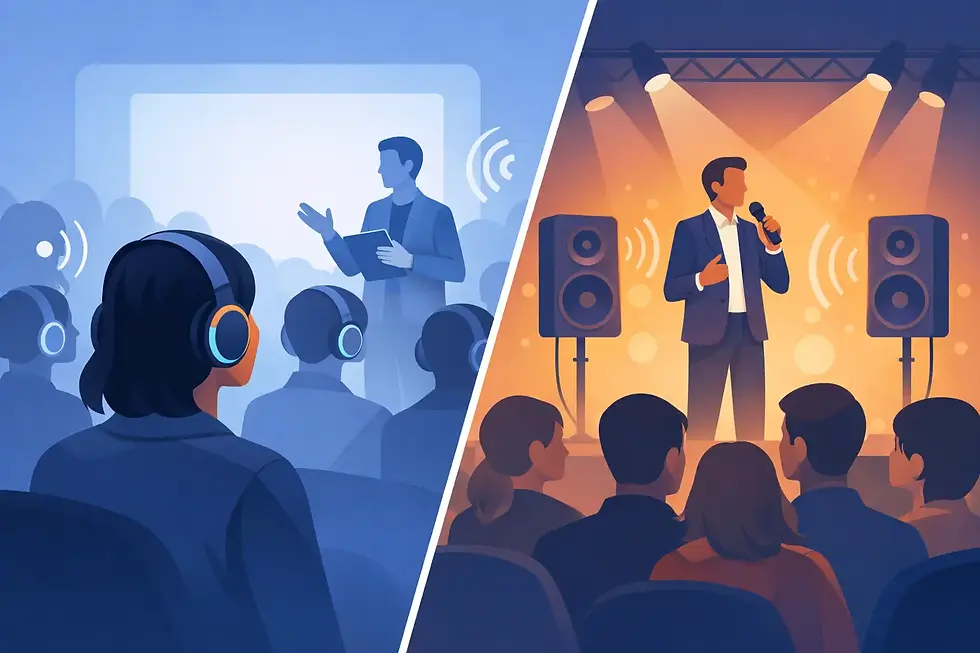
That is why many event organizers move beyond basic loudspeakers and start looking at directional coverage, wireless listening, assisted listening support, and closed-circuit audio options. These approaches do not just make sound louder. They make communication more precise.
For example, if your event includes multiple presentations happening side by side, adding more speaker output can actually make the problem worse. The audience hears everything at once, and no one gets a clean listening experience. In that case, a temporary system may need to include headphone-based audio delivery or separate wireless channels so attendees hear the content intended for them and nothing else.
The same logic applies to venues with heavy foot traffic. If your presenter has a strong message but the space is full of movement, chatter, and competing activity, focused audio delivery gives you a better result than simply turning up the mains.
Choosing the right temporary PA system for events
The best starting point is not equipment count. It is event conditions.
Begin with the venue. Is it indoors or outdoors? Carpeted ballroom or concrete expo hall? Open-air sports venue or retail floor? Acoustic conditions change everything. A room with echo may require careful speaker placement and tighter control. An outdoor event may need more output and weather-aware deployment. A crowded exhibit hall may call for distributed sound or wireless listening rather than a traditional front-facing PA.
Next, look at the program format. A keynote, panel, emcee-led activation, awards segment, fitness event, and product sampling demo all place different demands on the system. If multiple people will speak, microphone planning matters. If audience interaction is part of the event, you may need handheld wireless microphones, catch-box options, or a managed Q&A setup. If there is music, playback quality and source management become more important.
Audience behavior matters too. Are attendees seated and focused, or moving constantly? Are they there to listen, or are you trying to pull their attention from a noisy environment? A passive audience in a meeting room can be covered one way. A distracted crowd on a show floor needs a more deliberate strategy.
Then there is the operational side. Who is running the system? A simple setup may be manageable for on-site staff. A more dynamic event with multiple presenters, walk-up moments, cueing, and schedule changes usually benefits from technician support. Reliability often comes down to real-time management, not just gear quality.
The core components that matter most
Most event planners recognize the visible parts of a PA system - speakers, microphones, mixer. Those are still essential, but the details make the difference.
Microphone choice has a direct effect on clarity. A podium mic, lavalier, headset, and handheld do not solve the same problem. Headsets are often the strongest option for active presenters who need consistent vocal pickup. Lavaliers can work well, but only when placement, clothing, and movement are considered. Handhelds offer control and flexibility, especially for emcees and audience Q&A.
Speaker placement matters just as much as speaker type. You can have quality loudspeakers and still create poor coverage if the system is aimed badly, pushed too hard, or placed where it causes reflection and feedback issues. In many event spaces, more speakers at lower levels outperform fewer speakers blasting from one position.
Processing and mixing also deserve attention. Clear speech often depends on proper EQ, feedback control, gain structure, and active monitoring throughout the event. This is one reason custom deployment tends to outperform one-size-fits-all rentals.
And if the event has accessibility requirements, multilingual content, or multiple simultaneous presentations, the system may need assisted listening receivers, interpretation channels, or private broadcast options built in from the start.
When wireless and closed-circuit audio make more sense
There are plenty of events where a traditional PA is only part of the answer. If your venue is noisy, your presentations are happening close together, or your audience needs a more controlled listening experience, wireless audio delivery can be the stronger choice.
Closed-circuit audio systems are especially effective when you need to cut through the noise without adding to it. Attendees receive the presentation directly through headsets or receivers, so they hear the speaker clearly even in environments where open-air sound would struggle. This can be a major advantage for trade show booths, guided experiences, training zones, multilingual sessions, and VIP presentations.
It also helps with sound bleed. Instead of one activation interfering with the next, each audience gets its own clean feed. That creates a better attendee experience and makes life easier for venues and neighboring exhibitors.
For organizers trying to maximize engagement, that level of control is valuable. People stay with the message longer when they can hear it comfortably and without strain.
Common mistakes that cost events clarity
The most common mistake is underestimating the room. A planner sees the floor plan, guesses at the audience count, and assumes a basic PA will cover it. Then load-in happens, the room fills up, ambient noise rises, and speech clarity disappears.
Another issue is treating all content the same. Music playback can hide audio flaws that spoken word cannot. If your event is presentation-heavy, the system needs to be optimized for speech first.
There is also a tendency to separate audio from event strategy. In practice, they are closely connected. If you want stronger engagement, cleaner transitions, better sponsor visibility, or more effective announcements, audio has to be part of the planning conversation early.
And finally, many teams wait too long to ask whether attendees should hear the event through speakers, through wireless receivers, or through a combination of both. That decision shapes the whole setup.
A better approach: build around the listening experience
The strongest temporary event audio plans start with one question: how should people hear this?
If they need room coverage for announcements and energy, build a PA that delivers clear, controlled sound without excess spill. If they need focused listening in a crowded space, add wireless or closed-circuit audio. If the event includes accessibility needs, translation, or multiple concurrent sessions, plan for those functions from the beginning instead of treating them as add-ons.
This is where a consultative setup pays off. Rather than forcing the event into a standard package, you shape the system around the venue, the audience, and the communication goals. That leads to fewer surprises on site and a better return on the event itself.
At Your Event Audio, that is the difference we focus on: crystal clear audio solutions built for real event conditions, not generic assumptions.
If your next event depends on people hearing the right message in the right place, do not start with volume. Start with clarity, control, and a setup that fits the room you are actually walking into.


Comments